Sep 26, 2026Sensor & Safety Notes
Beam Sensors for Automatic Doors: 2-Beam vs 4-Beam Configurations
Two-beam and four-beam safety sensors protect different parts of a doorway. What each configuration detects, where the beams sit, and how to choose per opening.
Beam sensors are the workhorses of door safety. They project infrared beams across the opening and hold the door if anything interrupts them. The configuration question is simple to state and easy to get wrong: how many beams, and at what heights.
How a beam sensor works
A transmitter and receiver sit on opposite sides of the opening. The receiver watches for the beam; when a person or object crosses it, the beam is broken and the operator is told to hold or reopen. Because the detection is a physical line across the opening, it works regardless of whether the object is moving, which is why beam sensing suits presence detection rather than motion detection.
Two beams
A two-beam set gives one detection line at each of two heights, commonly set to cover the main walking corridor and a lower zone. It suits standard pedestrian doors where the traffic is people on foot and the opening is straightforward. It is economical and easy to align, and for many internal doors it is entirely sufficient.
Four beams
A four-beam set adds detection lines, which is useful when the doorway sees more than upright adults. Mixed traffic, trolleys, luggage, wheelchairs, children and deliveries all change what must be detected, and more beams across the height give more consistent coverage. Four-beam configurations are common on wider openings and on doors where the consequences of a missed detection are higher.
Mounting height and alignment
The height at which each beam sits is the design decision. Beams set for a typical adult corridor leave gaps at floor level, which is exactly where a crawling child or a low object appears. Beams set too low may be interrupted by wind-blown debris or floor-level reflections outdoors. The practical approach is to start from what the door will actually see and place the beams to cover it.
Reliability matters as much as count
Beam sensors are optical devices, and alignment is what keeps them working. Check how the unit is aligned and how tolerant it is of small movement over time, because a beam that drifts out of alignment produces nuisance holds or, worse, a door that no longer protects. Outdoor installations also need the units to cope with the light and weather conditions they will face.
Beams, curtains and presence sensors compared
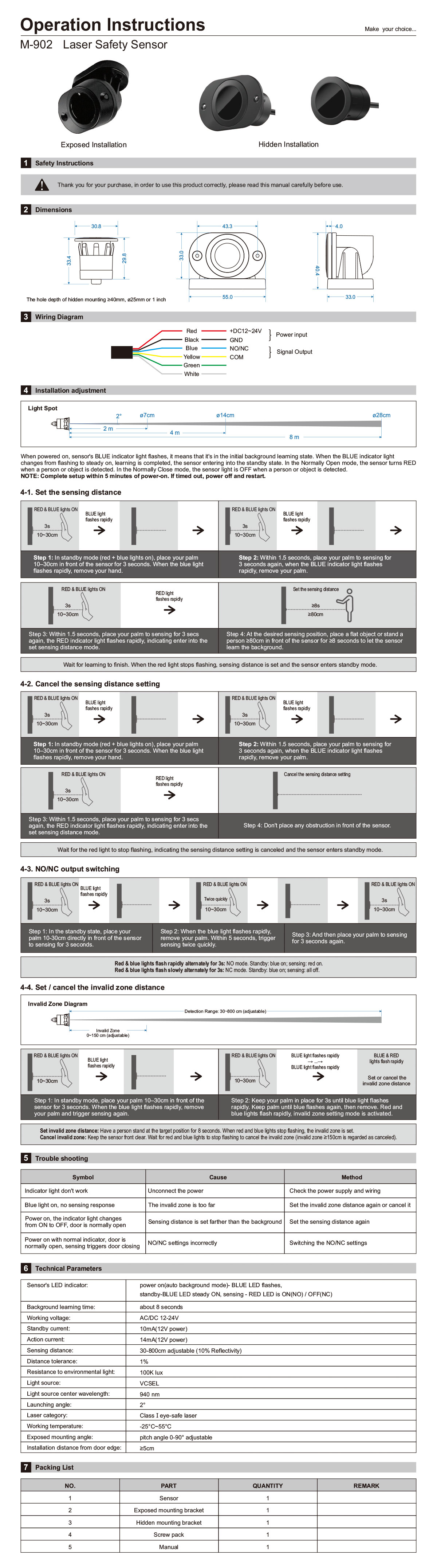
Beam sensors, safety curtains and presence detectors are often discussed as alternatives, but they answer slightly different questions. A beam sensor watches a line or a small number of lines across the opening. A curtain maintains a denser field across the leaf. A presence detector watches an area, and may use laser or infrared scanning rather than fixed beams.
The choice follows from what the opening looks like. A standard pedestrian door usually works well with beams or a curtain. An awkward or very wide opening often suits a scanning presence detector, because the coverage can be shaped to the space rather than fixed by the hardware. Where the traffic includes low or mixed shapes, the deciding factor is the coverage pattern at each height rather than the technology name.
Nuisance triggers and how to reduce them
Beam sensing is optical, so anything that interrupts the beam triggers it. Outdoors that includes blown debris, insects and even strong air movement across a heated beam path. Indoors it is rarely a problem. Where a door sees nuisance holds, the usual remedies are raising the beam position, tightening the alignment, and covering the opening so that weather does not cross the beam path.
Nuisance holds are worth taking seriously rather than tolerating, because a door that holds open at random trains people to ignore it, and that habit is what turns a safety device into decoration.
Frequently asked questions
Does more beams always mean safer?
Not automatically. Placement decides coverage. Four well-placed beams protect more than six aimed at the wrong heights, so choose the configuration from the traffic the door sees.
Can beam sensors be added to an existing door?
Usually yes, if the operator has an input for safety detection and there is a way to mount the units on both sides. Confirm the operator's inputs and the wiring route before ordering.
AURWEN supplies 2-beam and 4-beam safety sensors for automatic doors. Tell us your opening width and the traffic it sees and we will suggest a configuration.