Sep 26, 2026Sensor & Safety Notes
How to Choose a Presence Detector for Revolving Doors
Revolving doors need presence detection, not activation: what to install above the door, how detection zones work, and the checks that prevent the door from stopping mid-rotation.
A revolving door turns continuously, so the safety question is different from a sliding or swing door. There is no single leaf to hold open: the risk is a person inside the enclosure while the door keeps rotating. That is why revolving doors need presence detection rather than simple activation.
This guide covers what to install, where the detection zones should sit, and the checks that stop the door from catching somebody mid-turn.
Activation versus presence
Activation starts the door moving when someone approaches. Presence detection keeps watching the area while the door is in motion and tells the operator to slow or stop if a person is detected. A revolving door needs both: activation to start the rotation for an approaching visitor, and presence to protect anyone inside the enclosure.
Where the sensors go
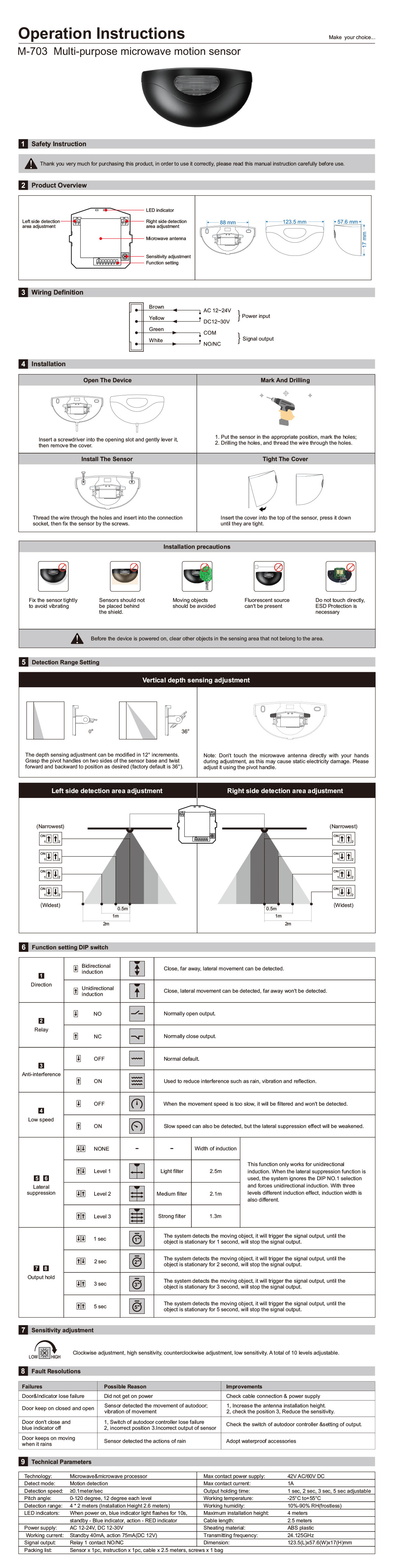
Detection on a revolving door is normally layered. A canopy-mounted sensor above the entrance watches the approach and starts the rotation. Presence sensors watch the enclosure and the areas immediately inside and outside the drum, so the door does not push into somebody who has stopped, turned around, or is moving more slowly than the rotation.
The critical zone is the pocket between the moving leaf and the fixed enclosure wall. This is where a person can be trapped if the only sensing is aimed at the approach path. Any presence system for a revolving door should be assessed against this zone specifically.
Mounting height and detection area
Canopy height decides the sensor. Common canopy-mounted presence sensors are specified for the heights used above revolving door drums, and the detection area must cover the full drum, not just the entry line. Check the datasheet's detection area at your actual canopy height rather than assuming the reference figures apply.
Technology choices
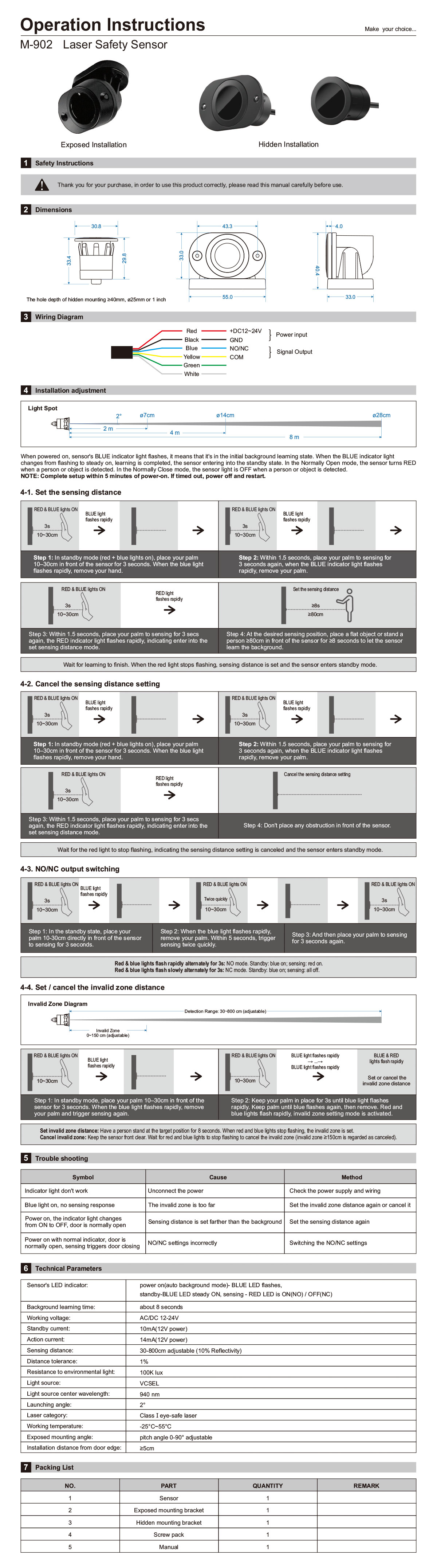
Active infrared and laser sensing are common for presence detection because they detect people who are standing still, which microwave motion sensing can miss. Laser safety sensors can scan a wider area with adjustable zones, and presence detectors built for revolving doors often combine several beams to cover the drum from more than one angle.
Where the entrance also serves a large public footway, an outer activation sensor with an adjustable field prevents the door starting for every passer-by while still opening in time for people actually entering.
Checks before ordering
Confirm the canopy height and the area available for mounting. Confirm what the door operator accepts for slow and stop signals, since presence detection only works if the operator can act on it. Confirm whether local accessibility requirements expect a stop-and-reverse behaviour or a slower rotation, and plan the wiring so presence sensors are not sharing a circuit that can be disabled by a mode change.
Revolving door versus swing and sliding doors
The three door families are often grouped together because they share operators and control hardware, but their safety problems are not the same. A sliding door presents a moving leaf that closes across an opening people walk through, so the risk is a leaf closing on somebody at the threshold. A swing door presents a leaf that travels through a space a person can occupy, so the risk includes being struck by the leaf itself.
A revolving door presents neither of those exactly. The leaf never closes an opening; it rotates continuously past the enclosure. The risk is a person inside the drum while the rotation continues, particularly in the pocket between the moving leaf and the fixed wall. That is why activation sensing designed for sliding doors does not transfer, and why presence detection inside the drum is the central requirement rather than a supplement.
Getting the detection zones right on site
On paper the layout looks straightforward; on site, three things decide whether it works. The first is where the canopy actually allows mounting, because the sensor positions must match the geometry the detection plan assumed. The second is where the drum's fixed walls create blind spots, since a sensor aimed from the canopy cannot see through the enclosure structure. The third is how the door behaves when it is busy, because a revolving door with a queue forming in the drum is the condition the presence sensing exists for.
Walking the installation before commissioning is worth the time. Stand in each position a person can occupy inside the enclosure, including the awkward ones near the wall, and confirm the presence system registers each of them. Testing only the straightforward centre-of-drum case is how a door passes commissioning and fails in service.
Accessibility and speed considerations
Many buildings expect revolving entrances to stay usable for people with restricted mobility and for anyone moving slowly. That expectation feeds into sensor selection: a door that only detects brisk, upright walkers has not met it. Rotation speed and hold time matter as much as the sensor, so commission them together.
It is also worth deciding how the door behaves when the presence system triggers: slowing is often preferable to an abrupt stop, so confirm the operator supports the behaviour you specify and that the sensor outputs map onto it.
Frequently asked questions
Can I use a normal sliding door sensor on a revolving door?
Not on its own. A sliding door activation sensor is aimed at the approach path and does not watch the enclosure, which is the area that matters on a revolving door. Revolving doors need presence sensing inside the drum as well.
Why does a revolving door sometimes slow down for no obvious reason?
Usually presence detection working as intended: a person in the drum, or in the zone just inside the enclosure, is being detected and the operator has been told to slow or hold. Hard safety sensors are deliberately conservative.
AURWEN supplies presence and safety sensors used on revolving and other automatic door systems. Tell us your canopy height and drum size and we will suggest a detection layout.