Sep 26, 2026Sensor & Safety Notes
Choosing Sensors for High or Oversized Door Openings: Why Height Ratings Matter
Tall and wide door openings break sensors that work fine on standard doors. Mounting height ratings, detection area at height, and the specifications to check before you buy.
A sensor that performs perfectly on a standard 2.1 m door can behave completely differently on a tall warehouse opening or an oversized architectural entrance. Detection area shrinks with height, beams spread, and the door's closing time gets longer. Height is not a detail; it is a selection criterion.
Why height changes everything
Manufacturers specify detection area at a reference mounting height. Raise the sensor and the same field is projected over a larger floor area, so it no longer matches the doorway. A field that neatly covered a normal entrance may, at twice the height, extend metres past the door and trigger on passing traffic. In the opposite direction, a sensor aimed for a low mount may leave a gap at the threshold when installed high.
Read the height rating first
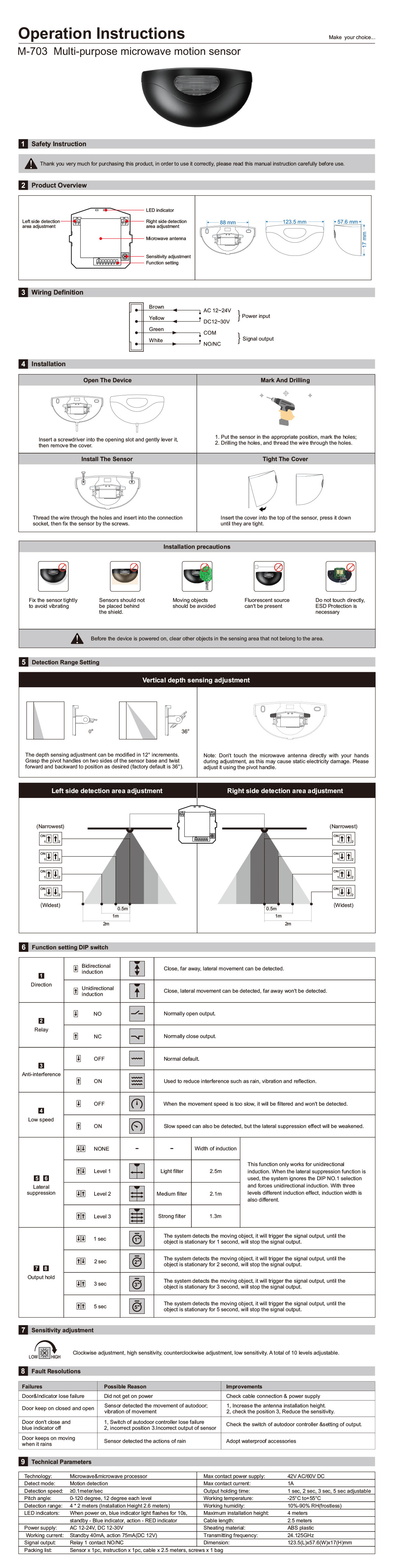
Before comparing anything else, check the sensor's specified maximum mounting height and the detection area given at your actual height. Common microwave sensors are rated for installation heights up to around 3,000 to 4,000 mm, and some can be customised for higher doors. If your opening is above the rated maximum, a standard model will not simply work at reduced performance; the geometry is out of specification.
Wide openings need coverage planning
On a wide opening, a single sensor may not cover the full leaf. Two sensors are often better than one wide-field unit, each aimed at its half of the opening, so detection stays consistent across the width. For sliding leaves especially, the detection must cover the whole path the leaf travels, not only the centre.
Safety on tall and wide doors
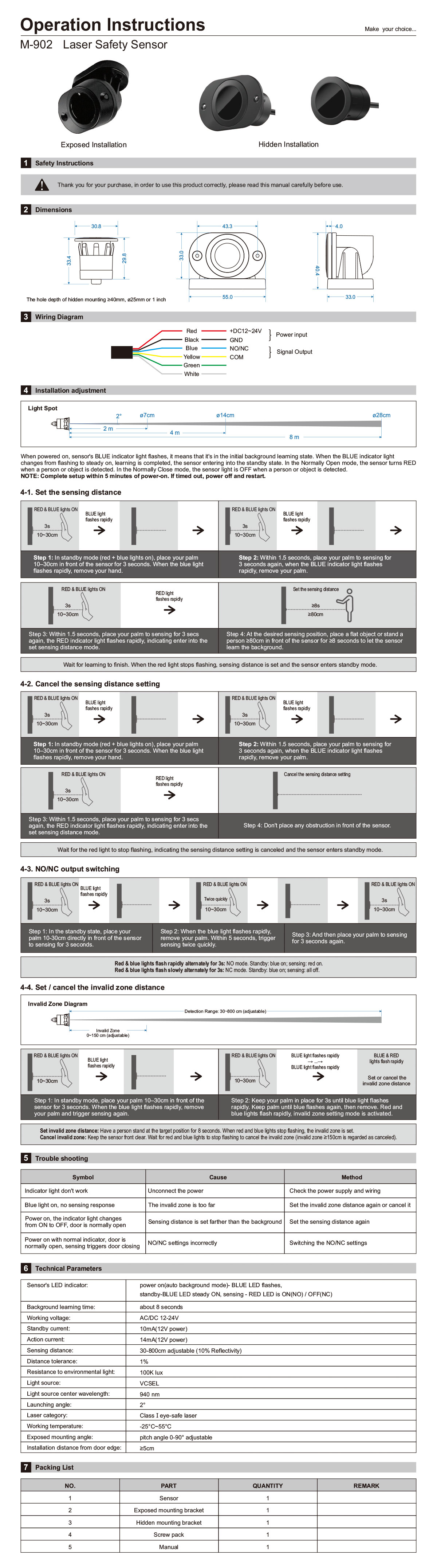
Tall doors take longer to close and the leaf travels further, so presence detection matters more, not less. Safety and presence sensors should be aimed to cover the threshold and the leaf path across the full width. On very tall openings, a laser safety sensor with an adjustable scan area often covers the geometry better than a fixed-field unit.
Practicals that catch people out
Check that the mounting position actually exists: high openings sometimes have no suitable header or canopy at the height the sensor needs. Check the wiring run and power available at that height. Confirm the sensor's field can be adjusted rather than fixed. And confirm that the door operator's hold and closing times can be set long enough for the extra travel, because a sensor is only useful if the door gives people time to pass.
Tall doors, hold time and pedestrian behaviour
Height affects more than detection geometry. A tall door takes longer to close, and the people using it include anyone moving slowly through a large opening. If the hold time is set for a standard door, a tall opening will begin closing while somebody is still crossing it. The sensor detects the person; the operator has to be given enough time to act on that detection.
This is why tall and oversized installations are best commissioned as a system rather than as a sensor plus a door. Set the hold and closing times against the actual travel of the leaf, with the safety detection active, and test with a person walking slowly across the whole width.
Retrofit versus new installation
On a new installation, height is simply a specification input and the sensor is chosen to match from the start. On a retrofit, the existing header height is fixed and the choice of sensor is constrained by it, which is when projects are tempted to stretch a model beyond its rating. The honest answer in that situation is usually to use more than one sensor, or a model with a wider height range, rather than to accept reduced detection.
Retrofits also raise the question of what the operator can accept. An older operator may not expose the inputs a modern presence arrangement wants, so confirming the operator's interface before choosing sensors prevents a specification that has to be reworked on site.
Frequently asked questions
Can I just aim a standard sensor further down?
Usually not. Aiming changes the angle, not the detection geometry the sensor was designed for, and it typically leaves gaps or overlarge areas. If your opening exceeds the rated height, choose a model rated for it.
How many sensors does a wide opening need?
It depends on the leaf width and the sensor's detection area at your mounting height. Measure the opening and compare with the specified field; if one sensor cannot cover the leaf path across its full width, use two.
AURWEN supplies motion, presence and laser safety sensors for automatic doors, including tall and wide openings. Send us your opening height and width and we will suggest a suitable layout.