Sep 9, 2026
Automatic Sliding Door Access Control Solution | AURWEN
See how access control, RFID readers, electric locks, exit switches and safety sensors work together in an automatic sliding door entrance system.
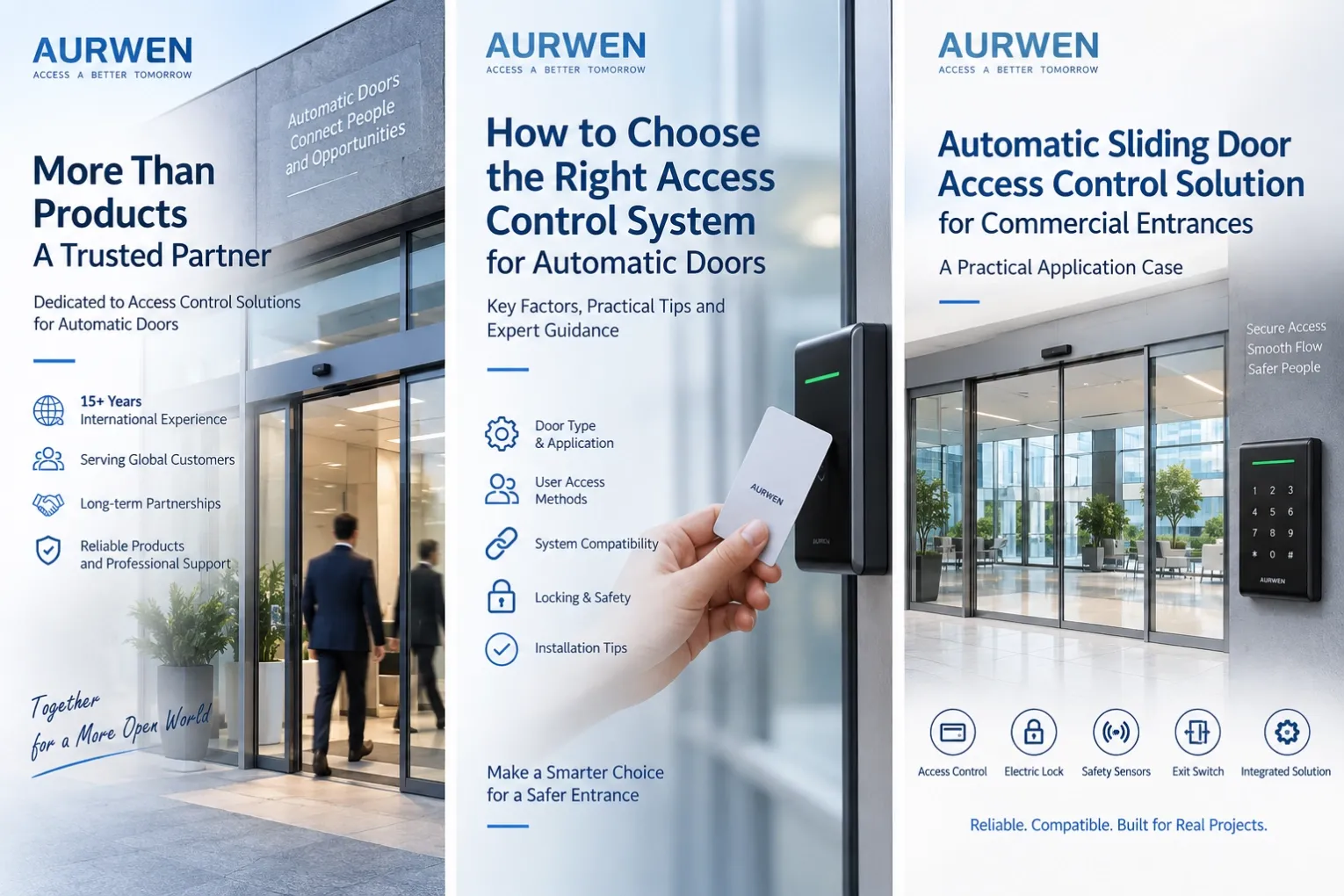
Automatic sliding doors are widely used in office buildings, retail stores, hotels, hospitals and other commercial facilities. While automatic opening provides convenient pedestrian access, many projects also require controlled entry, secure locking and safe automatic operation.
In this application example, AURWEN explains how an automatic door access control system can combine access authorization, door activation, electric locking and safety detection into one integrated entrance solution.
Application Scenario
Consider a typical office building with an automatic sliding entrance.
During business hours, employees need convenient access while visitors should not be able to enter restricted areas freely.
The project requirements are:
- Authorized staff can enter using an RFID card or PIN
- Unauthorized persons cannot activate the entrance
- People inside the building can exit conveniently
- The automatic door remains secured when closed
- Safety sensors protect pedestrians during door movement
- The system works together with the automatic sliding door operator
- Emergency access requirements can be incorporated according to local regulations
Instead of treating each device separately, the entrance should be designed as a complete system.


6
Recommended System Configuration
For this type of commercial automatic sliding door, a typical configuration can include:
Entrance Side
RFID Card Reader / Keypad
Employees present an authorized credential to request access.
↓
Access Control
Access Controller
The controller verifies the credential and sends the required output signal when access is authorized.
↓
Door Control
Automatic Sliding Door Operator
After receiving the authorized opening signal, the operator activates the automatic door.
↓
Locking
Electric Lock
The locking device works with the access control system to secure the entrance when required.
↓
Exit Side
Touchless Exit Switch or Exit Sensor
People inside the building can activate the automatic door without using an access credential where free exit is permitted.
↓
Safety Protection
Presence / Safety Sensors
Safety sensors monitor the doorway and surrounding detection area to support safe automatic door operation.
How Does the System Work?
The operating sequence can be straightforward.
When an employee approaches the entrance, the automatic door does not immediately open simply because someone is standing outside.
The employee presents an RFID card or enters an authorized PIN.
The access control system verifies the credential.
If access is approved:
Authorized Credential → Access Controller → Unlock Signal → Automatic Door Operator → Door Opens
Once the person passes through the entrance, the automatic door closes according to the operator settings and returns to its secured condition.
From inside the building, a touchless switch or exit sensor can be used for convenient exit if the project allows free egress.
Meanwhile, safety sensors operate independently from access authorization to detect pedestrian presence around the automatic doorway.
This separation between authorization, activation and safety is an important part of professional automatic door system design.
Why Are Safety Sensors Still Necessary?
One common misunderstanding is that installing access control means the automatic entrance is complete.
It is not.
An access control system answers:
“Is this person authorized to enter?”
A safety sensor addresses a different question:
“Is someone currently in or near the moving door area?”
For example, after an authorized employee activates the door, another person may still be passing through the doorway when the programmed hold-open time expires.
The safety detection system helps the automatic door operator respond appropriately to pedestrian presence.
Therefore, access control devices and automatic door safety sensors should not be treated as interchangeable components.
Where Can This Solution Be Used?
The same basic automatic door access control architecture can be adapted to many commercial applications.
Office Buildings
RFID or PIN access can restrict entry to employees while allowing convenient exit.
Hotels
Controlled doors can be used for staff areas, back-of-house entrances and other restricted zones.
Hospitals & Healthcare Facilities
Touchless activation and controlled access can be useful for staff-only areas, laboratories, pharmacies and other controlled departments.
Commercial Buildings
Automatic entrance systems can combine convenient pedestrian flow with controlled access during selected operating hours.
Banks & Financial Facilities
Higher-security areas may require more advanced authentication and locking strategies.
Warehouses & Industrial Facilities
Automatic doors can be integrated with staff access control to manage entry into controlled production or storage areas.


7
Different Projects Require Different Configurations
There is no single access control configuration that is suitable for every automatic door.
For example:
Office entrance
RFID Reader + Controller + Electric Lock + Exit Switch + Safety Sensor
Hospital staff entrance
Access Reader + Controller + Automatic Door Operator + Touchless Activation + Safety Sensors
Higher-security entrance
Biometric Reader + Access Controller + Electric Lock + Door Status Monitoring + Controlled Exit
Public commercial entrance
Motion Sensor + Automatic Door Operator + Safety Sensors, with access control activated only during restricted operating periods
This is why the project application should always be understood before selecting individual products.
What Should Be Confirmed Before Installation?
For an automatic sliding door project, the installer should confirm several technical details before finalizing the system:
- Automatic door operator model
- Door type and opening configuration
- Access control method
- Reader and controller interface
- NO/NC/COM signal requirements
- Electric lock type
- Operating voltage
- Free exit or controlled exit requirement
- Safety sensor configuration
- Door status monitoring requirements
- Fire alarm or emergency interface requirements
Confirming these points before installation can reduce compatibility problems and unnecessary troubleshooting on site.
AURWEN Automatic Door Access Control Solutions
With over 15 years of experience serving international customers, AURWEN focuses on access control, activation and safety solutions for automatic door applications.
Our solutions cover products such as:
Access Controllers
RFID Readers & Keypads
Automatic Door Sensors
Safety & Presence Sensors
Touchless Switches
Push Buttons
Remote Controls
Electric Locks
Automatic Door Accessories
We work with automatic door distributors, installers, system integrators and project contractors to help match the right components to different automatic entrance applications.
Our approach is not simply to provide individual devices. We focus on how the products connect, communicate and operate together within the automatic door system.
Need a Solution for Your Automatic Door Project?
Every project is different.
Send AURWEN your:
1. Door type
2. Automatic door operator model
3. Required access method
4. Project application
Our team can help you identify the appropriate access control, activation and safety configuration for your automatic door system.