Sep 26, 2026Access Control Guides
How to Choose an Access Keypad for Outdoor Gates and Doors
Outdoor keypads fail on water, temperature and vandalism long before they fail electrically. Waterproofing, mounting, code management and the checks that matter before buying.
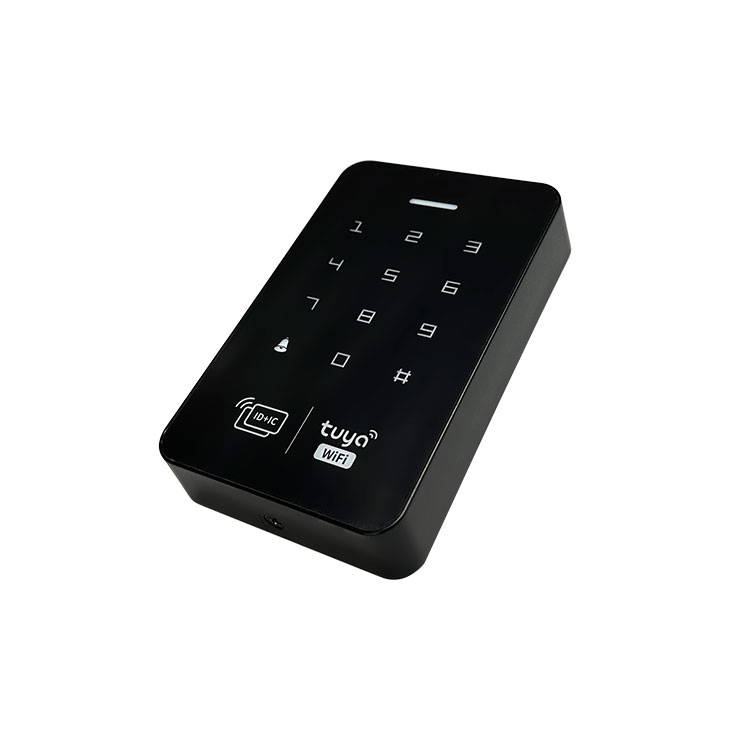
An indoor keypad installed on an external gate tends to fail in a predictable order: moisture first, then temperature, then the keypad itself. Choosing for outdoors is mostly about deciding what the installation will be exposed to, and buying for that rather than for the indoor specification at a lower price.
Waterproofing is the first question
Not every unit sold as weather-resistant is intended for sustained rain. Look for an explicitly stated waterproof or weatherproof rating, and read what the manufacturer says the device is rated against rather than assuming. A keypad on a sheltered porch and one on an exposed gate post see very different conditions.
Mounting and physical protection
Position matters as much as the product. Mount under a canopy or recess where possible, keep the unit clear of standing water and sprinkler spray, and angle the face so rain runs off rather than into the keys. On public or semi-public gates, consider mechanical protection: a metal-bodied keypad resists impact and forced entry far better than a thin plastic face.
Temperature range
Outdoor installations swing far wider than indoor ones. Check the operating temperature range against the local climate, including the extremes rather than the averages, because a keypad that fails in the first cold snap or heatwave is a warranty argument nobody wants.
Credentials and code management
Decide what the keypad must accept. A PIN-only unit needs no credentials but codes get shared and need changing. A keypad that also reads cards or tags lets regular users carry a credential while visitors use a code, which is usually easier to manage. Look at how codes are added and removed: some units are programmed at the device, others through a controller, and the difference shows up every time staff change.
Integration with the gate or door
The keypad has to drive a lock or operator. Confirm the output type the keypad provides and the input your lock or operator expects, and confirm the voltage the installation provides. On vehicle gates, also confirm whether the keypad needs to work with an existing intercom, exit loop or remote receiver without conflicting with them.
Keypad, reader and intercom on one gate
Vehicle and pedestrian gates often end up with more than one way in: a keypad for codes, a reader for staff tags, and an intercom or remote for visitors and deliveries. Individually these are simple; together they raise the question of who arbitrates. A gate where the intercom, the keypad and an exit loop can all operate the same lock needs a clear answer about precedence, or the gate behaves inconsistently depending on which device was used first.
The practical approach is to route the credentials through one controller where the access rules live, and to treat the keypad as one credential source among several rather than as a standalone lock driver. That keeps codes, tags and visitor releases governed by the same rules and makes revocation a single operation.
Codes, sharing and revocation
Codes are convenient and they leak. A shared code eventually becomes a public code, and the only real defence is being able to change it quickly and to give different people different codes. Before choosing a keypad, decide how codes will be issued, how many the unit supports, and how a code is removed when somebody leaves. A keypad that makes revocation awkward will accumulate stale codes, and stale codes are the same as no access control at all.
Frequently asked questions
Can an indoor keypad be used outside if it is under a roof?
A sheltered position reduces exposure but does not change the product's rating. If the location is genuinely dry year-round, an indoor unit may survive; if wind-driven rain reaches it, it will not, and a rated unit is the cheaper decision.
Should the keypad control the lock directly or through a controller?
Through a controller where more than one door, credential type or access rule is involved, because the rules live in one place. Direct control is simpler for a single gate with a single code.
AURWEN supplies waterproof access keypads, including units that accept both PIN codes and IC or ID cards, for gates and external doors. Tell us the exposure and the credentials you want to support and we will suggest a model.