Sep 9, 2026
How to Choose an Access Control System for Automatic Doors | AURWEN
Learn how to choose the right access control system for automatic doors, including readers, sensors, electric locks, exit switches and operator compatibility.
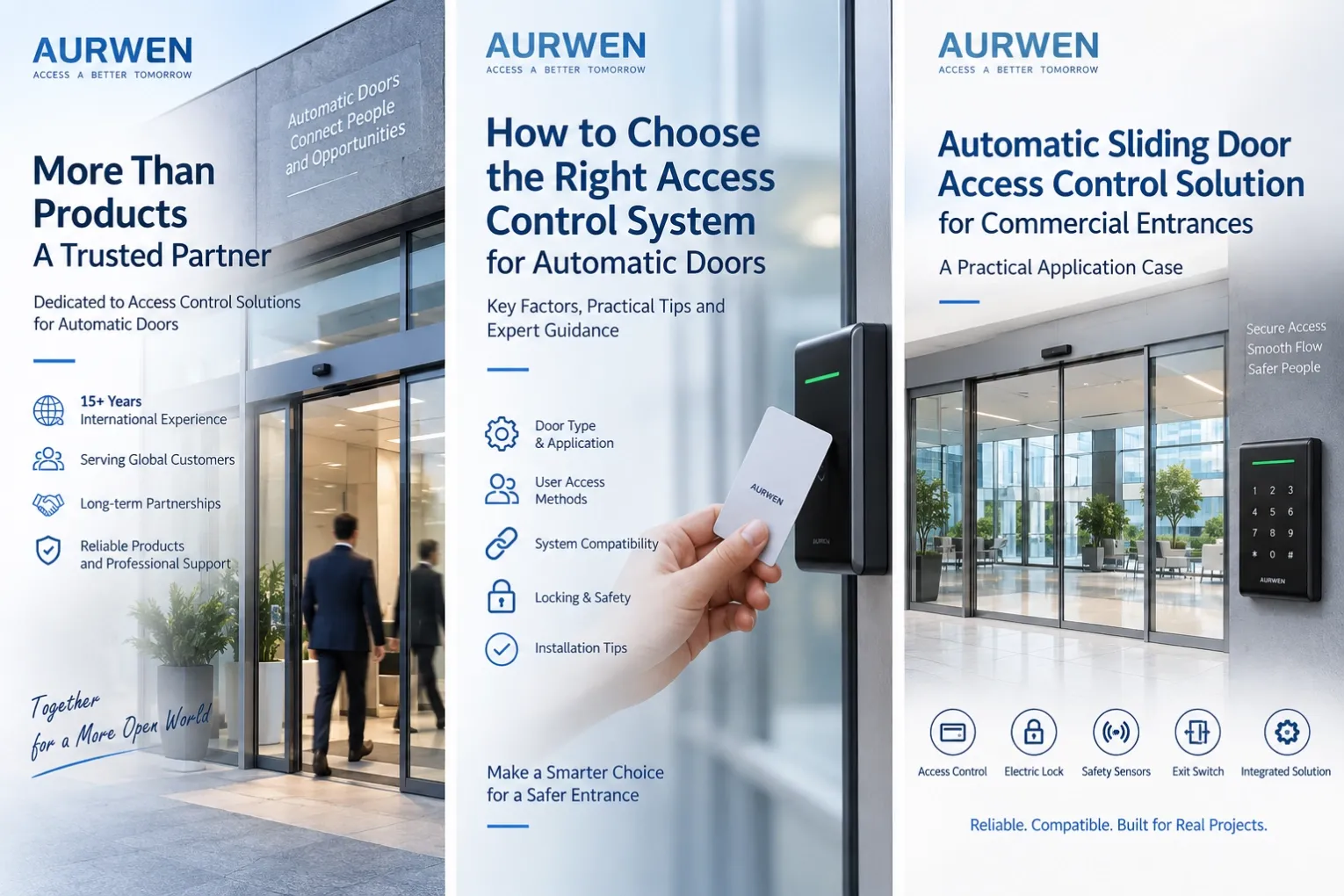
Choosing the right access control system for an automatic door involves much more than selecting a card reader or keypad. A reliable automatic entrance requires the access control device, activation sensor, safety sensor, electric lock and automatic door operator to work together as one integrated system.
For installers, distributors and project contractors, selecting the wrong combination can lead to compatibility issues, unreliable operation, unnecessary installation work and even safety risks.
With over 15 years of experience serving international customers, AURWEN recommends considering the following key factors when selecting an access control solution for an automatic door.
1. Start with the Door Type
The first step is to identify what type of automatic door will be controlled.
Common applications include:
- Automatic sliding doors
- Automatic swing doors
- Telescopic sliding doors
- Hospital and healthcare doors
- Commercial entrance doors
- Office and restricted-area doors
- Cleanroom and controlled-access doors
Different door systems may require different activation methods, locking solutions and safety devices.
For example, an automatic sliding entrance in a retail environment may primarily use motion sensors for convenient entry, while an office or restricted area may require card, PIN or biometric authentication before the automatic door operator receives an opening signal.
The access control system should therefore be selected according to the door application, rather than treating the access control device as an independent product.
2. Define Who Should Be Allowed to Enter
Before choosing the hardware, determine how users will be authorized.
RFID Card or Key Fob
RFID access control is widely used for offices, commercial buildings, staff entrances and other controlled areas.
It is suitable when authorized users need fast and convenient daily access.
PIN Keypad
A keypad allows users to enter a password or PIN without carrying a physical credential.
It can be suitable for offices, warehouses, staff areas and other applications where access needs to be controlled without issuing cards to every user.
Biometric Access Control
Fingerprint, facial recognition and other biometric technologies can provide a higher level of identity verification.
They may be considered for applications requiring stronger personnel identification or centralized access management.
Mobile or Remote Access
For some modern projects, access authorization can also be managed through smartphones, wireless transmitters or centralized building management systems.
The correct choice depends on the required security level, number of users, frequency of access and management method.
3. Check Compatibility with the Automatic Door Operator
This is one of the most important points—and one that is sometimes overlooked.
The access control system must communicate correctly with the automatic door operator.
In a typical installation, the process may be:
Credential → Access Controller → Door Opening Signal → Automatic Door Operator → Door Opens
The installer should confirm several technical details, including:
- Relay output type
- NO/NC/COM contacts
- Required input signal
- Operating voltage
- Lock output
- Door status input
- Exit device connection
- Timing requirements
Many automatic door operators accept a dry contact / potential-free contact as an opening command. However, this should always be verified according to the operator specifications.
Never assume that two devices are compatible simply because their operating voltages are similar.
4. Choose the Correct Electric Lock
Access control and locking are closely connected.
Depending on the door type and security requirements, the system may use:
- Electric locks
- Electromagnetic locks
- Electric strikes
- Automatic door-specific locking devices
- Motor locks
The correct lock depends on the door construction, operator, required holding force, emergency release requirements and access control logic.
It is also important to consider what should happen during a power failure.
Should the door remain locked?
Should it unlock automatically?
Should authorized personnel still be able to open it manually?
These questions should be answered during system design—not after installation.
5. Access Control and Door Safety Are Not the Same Thing
This distinction is particularly important for automatic doors.
An access control device determines whether a person is authorized to enter.
A safety sensor helps prevent the moving automatic door from creating a hazard.
They perform completely different functions.
For example, a card reader may authorize the door to open, but the automatic door system may still require presence or safety sensors to detect people in or near the door movement area.


6
For professional automatic door projects, the access control solution should therefore be considered together with the activation and safety system.
6. Select the Right Exit Method
Controlling entry is only half of the system.
You also need to decide how people will exit.
Common options include:
Touchless Exit Sensor
Suitable for applications where hygienic, contact-free activation is preferred.
Push-to-Exit Button
A simple and reliable solution for many commercial applications.
Motion Sensor
Frequently used where free exit and automatic activation are required.
Controlled Exit
For higher-security applications, both entry and exit may require authorization.
The appropriate solution depends on the security requirements and the intended flow of people through the entrance.
7. Consider the Application Environment
A product that works well in an office may not be the best choice for a hospital, warehouse or outdoor entrance.
Before selecting an access control system, consider:
Indoor or outdoor installation
Outdoor devices may require appropriate weather protection.
Temperature and humidity
Environmental conditions can affect electronics and sensors.
Traffic frequency
High-traffic entrances require components designed for frequent operation.
Healthcare environments
Hospitals may place greater emphasis on hygienic touchless activation, reliability and controlled access.
Commercial buildings
Appearance, user convenience and integration with building security systems may be important.
This is why professional product selection should always begin with the application.
8. Don't Forget Emergency and Fire-Safety Requirements
Access control should never interfere with required emergency escape functions.
Depending on the building and local regulations, an automatic entrance may need to interface with:
- Fire alarm systems
- Emergency release devices
- Emergency stop functions
- Building management systems
- Emergency power supplies
- Fail-safe locking arrangements
Requirements vary between countries and projects, so installers should always follow applicable local building, fire and accessibility regulations.
For project applications, these requirements should be confirmed during the system design stage.
9. Think About Integration Before Installation
A professional access control solution should not be viewed as a collection of separate devices.
Consider the complete entrance:
Who activates the door?
Who is authorized to enter?
How does the operator receive the opening command?
How is the door locked?
How does the system detect people around the moving door?
How will users exit?
What happens during an emergency or power failure?
When these questions are answered together, product selection becomes much easier.
A Simple Automatic Door Access Control Configuration
A typical controlled automatic sliding door might include:
Outside:
RFID Reader / Keypad
↓
Access Controller
↓
Electric Lock + Automatic Door Operator
↓
Inside:
Touchless Exit Switch
At the same time:
Safety / Presence Sensors → Automatic Door Operator
This creates a system in which access control, door activation and pedestrian safety perform separate but coordinated functions.
Common Mistakes When Choosing Automatic Door Access Control
Several problems can be avoided during the product-selection stage.
Choosing by price alone can result in unreliable products or unnecessary replacement costs.
Ignoring operator compatibility may cause communication or installation problems.
Using an access control reader as a substitute for a safety sensor misunderstands the function of the automatic door system.
Selecting the lock without considering power failure behavior can create security or emergency-exit problems.
Buying individual components without considering the complete system often increases installation time and troubleshooting.
For professional projects, the better approach is to select products based on the complete automatic door application.
Choosing the Right Solution with AURWEN
At AURWEN, our focus is on access control, activation and safety solutions for automatic door applications.
With more than 15 years of international industry experience, we understand that professional customers need more than individual products. Compatibility, reliability and correct system configuration are equally important.
We support automatic door distributors, installers, system integrators and project contractors with product selection and application-based solutions for different automatic entrance systems.
If you are not sure which access control, sensor, switch or locking solution is suitable for your automatic door, send us your door type, automatic door operator model, access requirements and project application.
Our team will help you identify a suitable solution for your project.