Sep 26, 2026Access Control Guides
Touchless vs Touch Switches for Automatic Doors: Hygiene, Cost and Retrofit
Touchless switches win on hygiene and accessibility; touch and press switches win on simplicity and cost. A practical comparison to help you choose per door, not per fashion.
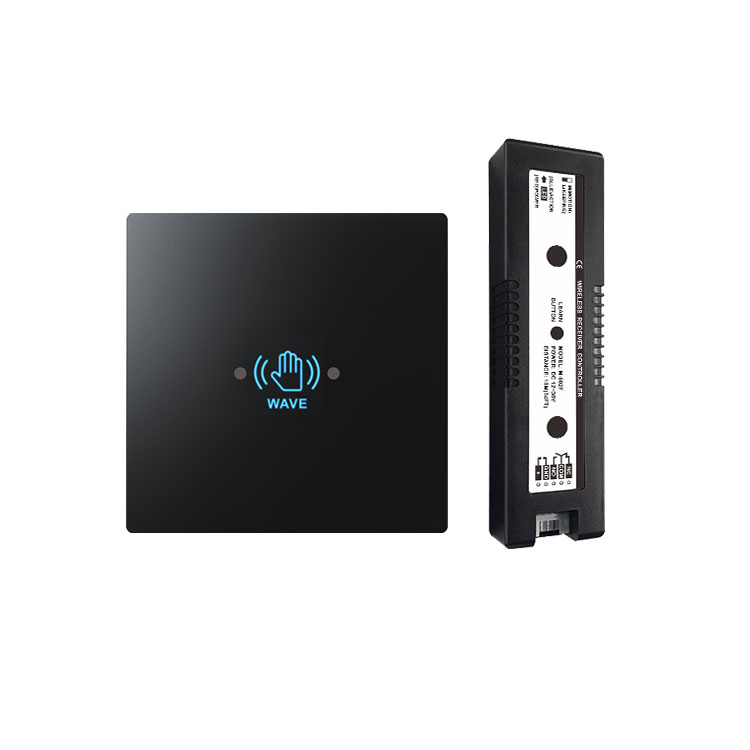
Since hygiene became a headline requirement for public buildings, touchless switches have moved from nice-to-have to specification default on many doors. But touch and press switches still have real advantages, and choosing per door — rather than per fashion — gives the best result for the budget.
Where touchless clearly wins
Anywhere hands should not touch a shared surface: hospital corridors, clinic and treatment rooms, laboratories, commercial kitchens, food-processing areas, and public washroom entrances. A touchless switch uses an infrared sensor to detect a approaching hand and opens the door with no contact at all, which removes the shared-surface hygiene problem entirely and makes the door usable when hands are full or dirty.
Accessibility is the second win. No grip, no push, no precise aim — a person with limited mobility or full hands waves near the panel and the door responds. Detection zones of roughly 1–20 cm are common, and backlit panels make the target obvious.
Where touch or press switches still make sense
Touch and press switches are simpler, cheaper and mechanically honest: what you press is what switches. They suit staff doors, plant rooms, storage areas and any door where hygiene pressure is low and users are known. A metal touch panel also survives vandalism-prone locations well, and there is no sensor to mis-trigger.
Press buttons are also the fallback design in many safety discussions: a deliberate, physical action to open a specific door is sometimes exactly the intent — fire-exit assist buttons and disabled-access buttons are press-style for a reason.
The retrofit question
Both families retrofit well on the 86×86 mm wall-box standard. The real constraint is cabling: a wired touchless switch needs power at the panel, while a wireless kit (battery transmitter + receiver at the operator) avoids cabling altogether — useful across glass, stone or tiled walls. Modern 2.4 GHz wireless switches pair by self-learning code, so a second switch can be added without rewiring.
Cost over the life of the door
Touchless panels cost more up front. Weigh that against what the door is for: in a hospital the hygiene benefit is the point, and the premium is trivial; in a storeroom it is money spent for nothing. Wireless adds battery replacement to the maintenance list — a small cost, but a real one, so check the transmitter's battery-life specification.
A simple decision rule
Public or hygiene-critical door → touchless. Staff or service door → touch or press. Retrofit across an untouchable facade → wireless, in whichever panel style the door needs. Mixed buildings usually end up with both families, chosen door by door.
Frequently asked questions
Do touchless switches trigger from passing traffic?
Good ones do not — the infrared detection zone is tuned to a short range in front of the panel (typically 1–20 cm), so corridor traffic does not open the door.
Can a touchless switch also lock the door?
Yes — special-room switch panels combine touchless or touch opening with lock indication and occupied/vacant status for washrooms and private rooms.
AURWEN supplies touchless, touch and press switch families — wired and wireless — for hygiene doors, accessibility doors and service doors alike. Contact AURWEN for panel recommendations per door.